
0
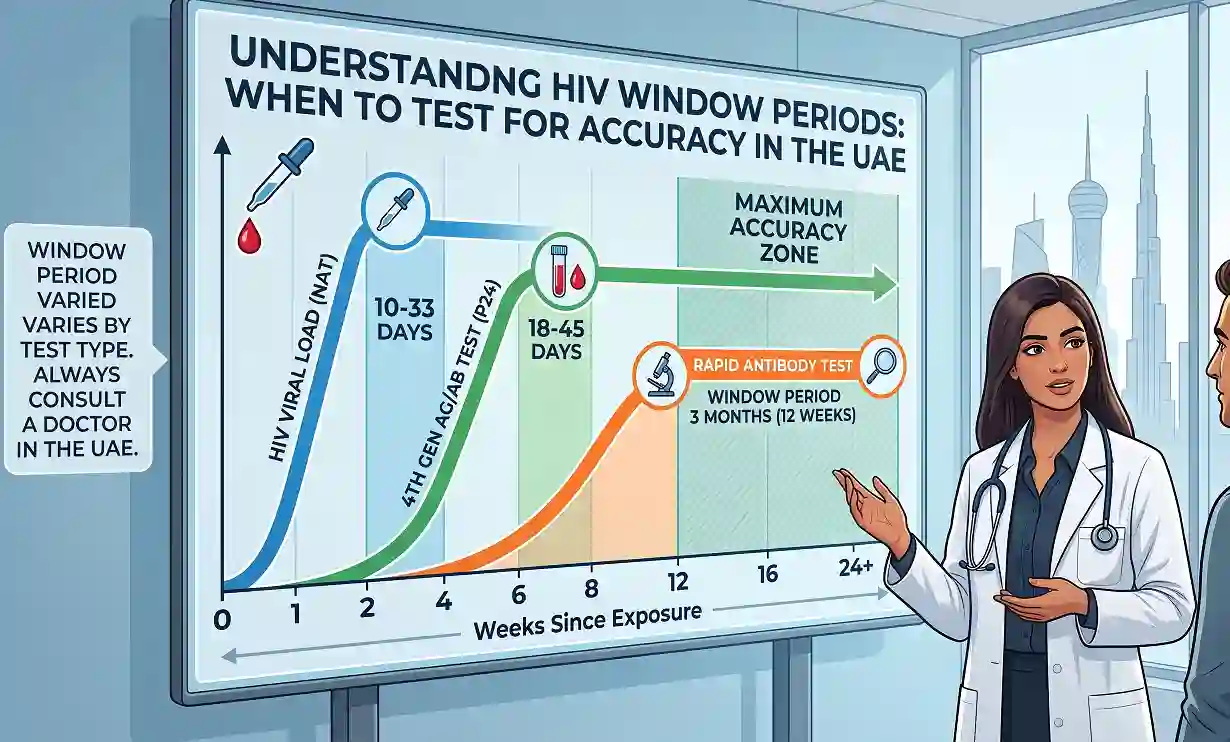
If you’ve recently had a potential exposure to HIV, waiting to test can feel overwhelming. Your mind fills with questions: How long should I wait? Will the test be accurate? Can I trust a home test?
The answer lies in understanding the HIV window period — the critical gap between exposure and the point when a test can reliably detect the virus. Testing too early might give you a false sense of security. Testing at the right time gives you a result you can trust.
This guide explains the window period for 4th generation HIV tests, the difference between antigen and antibody detection, and exactly when you should test for an accurate result — all from a UAE perspective, with privacy at the core.
The HIV window period is the time after infection during which a test cannot yet detect the virus or your body’s response to it. Even though HIV enters your body immediately upon exposure, it takes time for detectable markers to appear in your blood.
Testing inside this window can produce a false-negative result — meaning you have the infection, but the test shows negative because there aren’t enough markers yet.
Understanding this timeline is the single most important factor in getting an accurate result.
To understand the window period, you need to know what each test looks for.
| Test Generation | What It Detects | Window Period |
|---|---|---|
| 3rd Generation | Antibodies only (IgM/IgG) | 3–4 weeks for most; conclusive at 12 weeks |
| 4th Generation | p24 antigen + antibodies (IgM/IgG) | 2–4 weeks for most; conclusive at 6 weeks |
The p24 protein is part of the virus itself. It appears in the blood within 10–14 days after infection, before your body has produced antibodies. A 4th generation test can detect this antigen, drastically shortening the window period.
Your immune system produces antibodies to fight HIV. These become detectable typically 3–4 weeks after exposure. A 3rd generation test relies solely on this antibody response, which is why its window period is longer.
GulfTestZone’s home HIV test kit is a 4th generation rapid test — it detects both p24 antigen and HIV-1/2 antibodies, giving you the earliest possible detection from a finger-prick sample.
View the 4th Gen HIV Test Kit →
This timeline shows how test accuracy increases as time passes after a suspected exposure.
| Time After Exposure | 4th Gen Test Accuracy | What It Means |
|---|---|---|
| 0–1 week | Not reliable | Virus is present but markers are undetectable. |
| 2 weeks (Day 14) | ~50–60% | p24 antigen may start appearing. Some early cases can be detected. |
| 3 weeks (Day 21) | ~80–90% | Most infections now detectable, especially with high viral load. |
| 4 weeks (Day 28) | ~95–99% | Considered highly reliable. A negative result at 4 weeks is very reassuring. |
| 6 weeks (Day 42) | >99% (Conclusive) | UK, WHO, and UAE Ministry guidelines accept 4th gen negative at 6 weeks as conclusive. |
| 12 weeks | Conclusive for all test types | If using an older 3rd generation test, this is the gold standard deadline. |
Key takeaway: With a 4th generation kit, a negative result at 6 weeks is considered conclusive. No further routine testing is required unless a new exposure occurs.
Testing at 1 or 2 weeks might give you a negative result — and a dangerous false peace of mind. A person with a false-negative result might unknowingly continue high-risk behavior, potentially transmitting the virus to others.
The emotional toll also matters. An unclear or mistimed test can fuel anxiety, leaving you doubting the result. Testing at the right time brings clarity, closure, or the path to early treatment.
In the UAE, where access to private clinics involves paperwork and insurance trails, a home HIV test kit allows you to test discreetly at exactly the 4-week or 6-week mark — no appointments, no waiting rooms, no records.
Some situations demand the earliest possible screening — for example, after a high-risk occupational exposure or to ease extreme anxiety. In these cases, a test with very high analytical sensitivity, such as an ELISA (Enzyme-Linked Immunosorbent Assay) 4th generation test, can be used.
Our HIV 1/2 Combo ELISA Test Kit is a laboratory-grade format that also detects antigen and antibodies simultaneously. While it requires a slightly larger blood sample, it offers exceptional early sensitivity and is often used for confirmation after a rapid test.
Note: ELISA kits are designed for healthcare settings, but GulfTestZone supplies them for informed self-use alongside our rapid cassette option.
A reactive result on a rapid home test is not a final diagnosis. It must be confirmed by a laboratory-based test, such as a Western blot or PCR test, at a licensed medical facility.
Steps to take:
Do not panic. A reactive result is a screening signal, not a final answer.
Order a second, different-format test for immediate confirmation, like our ELISA kit.
Visit a government hospital or private clinic for a confirmatory blood draw.
Remember that HIV is now a manageable chronic condition with effective treatment (ART).
The UAE offers free HIV treatment for citizens and subsidized care for residents. Early detection means a near-normal life expectancy.
Worried about privacy? GulfTestZone ships every order in completely unmarked packaging. No medical branding appears on the outside, and your bank statement shows a neutral billing descriptor.
Delivery is available to Dubai, Abu Dhabi, Sharjah, Ajman, Ras Al Khaimah, Fujairah, and Umm Al Quwain — usually within 24–48 hours in major cities.
Order your discreet HIV test kit now →
Can I test for HIV immediately after unprotected sex?
No. Testing immediately will not detect the virus. You must wait at least 2–3 weeks for a 4th generation test to pick up the p24 antigen, or 4 weeks for very high accuracy.
Is a 4-week negative result reliable?
Yes, a 4th generation test at 4 weeks is 95–99% accurate. For complete peace of mind, repeat the test at 6 weeks — that is considered conclusive.
What if I used an older 3rd generation test?
If you tested with a 3rd generation kit, a negative result is conclusive only at 12 weeks. You can upgrade to a 4th generation test for earlier accuracy.
Does the window period change with different HIV strains?
No. 4th generation tests are designed to detect HIV-1 (including rare subtypes) and HIV-2, covering all clinically relevant strains.
Where can I learn how to use the test correctly?
We have a detailed guide: How to Use a Home HIV Test Kit Correctly – Step-by-Step Guide for UAE — read it before you test for the most accurate result.
Testing at the right time is the difference between uncertainty and clarity. With a 4th generation home HIV test kit, you can take control of your health privately, accurately, and on your own terms.
Wait for the window period. Trust the science. And if you’re ready, test with confidence — wherever you are in the UAE.
Get your 4th Gen HIV Rapid Test Kit today →
Disclaimer: This article is for educational purposes only and does not replace professional medical advice. If you test reactive, please seek confirmatory testing and consultation with a licensed healthcare provider.
Order your discreet test kit today with fast delivery across the UAE.
Shop Now